
A postcard from the Wirral
Drawn to the peninsula’s big tides and even bigger skies, we followed in the hoofprints of an Arthurian knight.

When a mysterious green knight arrives at Camelot, young Gawain is the only one of Arthur’s retinue brave (or foolish) enough to accept his challenge: strike him with his axe, but take a return blow in a year and a day. Gawain beheads the green knight, who then stands, picks up his head, and reminds Gawain of their deal.
The story of Gawain’s quest to meet the knight at the Green Chapel is told in a 14th-century poem by an unknown author. During the tale, Gawain crosses the Dee Estuary from Wales and lands on the Wirral peninsula, an area the poet describes as a ‘wilderness’:
In þe wyldrenesse of Wyrale; wonde þere bot lyte
Þ at aþuer God oþer gome with goud hert louied
In the wilderness of Wirral dwelt there but few
That either God or man with good heart loved.
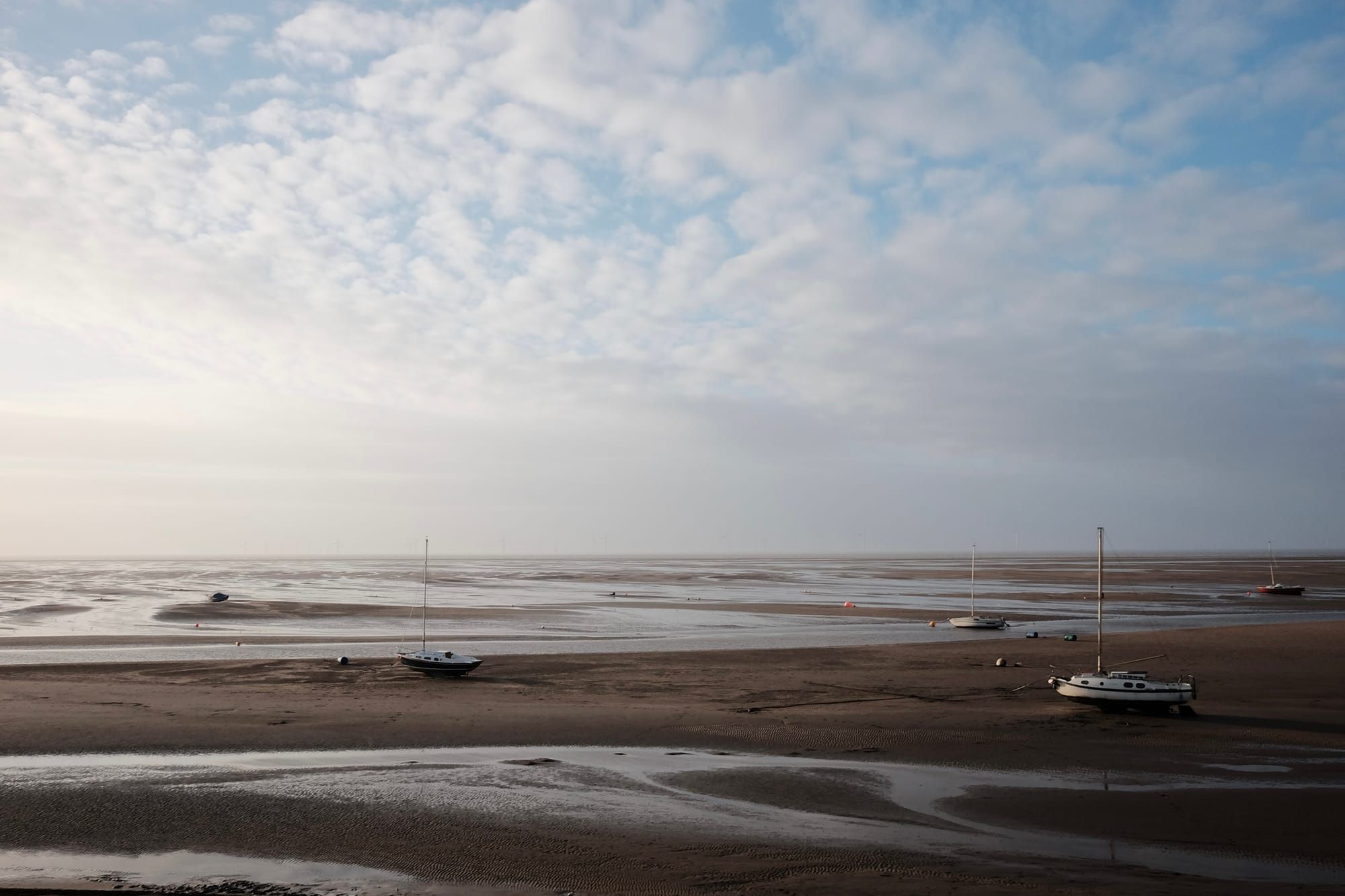
When the tide falls, you can imagine how this place might have felt back then. Vast. Forbidding. But we were not slogging across a wilderness towards our fate. Our quest was a little different from Gawain’s: a few days of exploring on foot and by public transport from Meols. Wandering and eating ice creams.
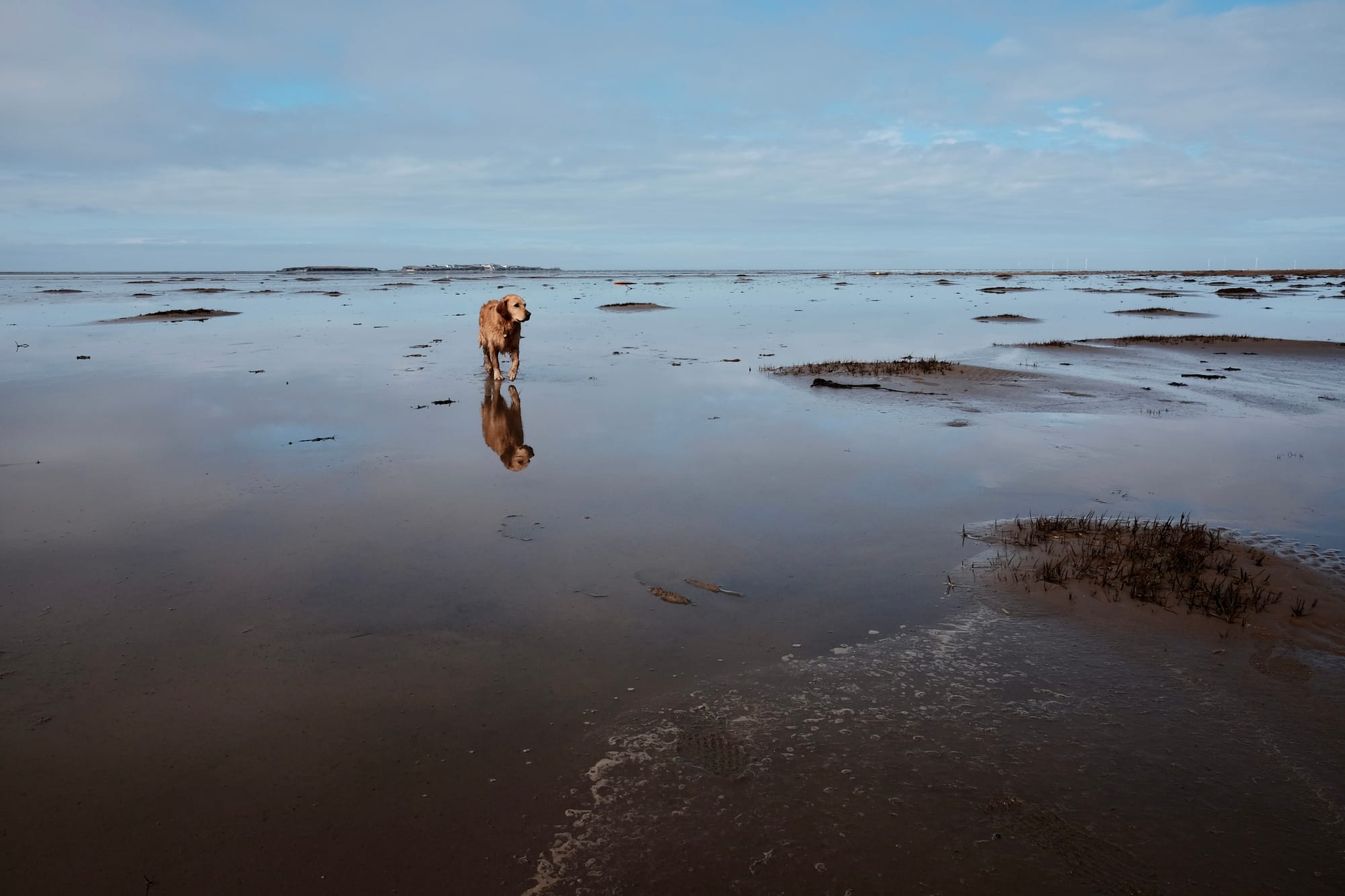
I’ve written before about the joy of walking along the foreshore, of immersing ourselves in the liminal space where sea meets land. For fans of a foreshore stroll, the Wirral is ideal. The River Mersey has the second-highest tidal range in the UK, with variations from 4 metres at neap tides to 10 metres at spring tides. When the tide’s out, it feels as though you could walk to Wales.
You wouldn’t make it across to Prestatyn on foot, of course. The Dee Estuary would claim you. But it is possible to walk as far as the Hilbre Islands nature reserve – if you stick strictly to the safe route out across the sands from West Kirby, and return well before the tide rises. With an overexcited Golden Retriever in tow, we left the island’s grey seals and flocks of wading birds in peace, heading inland to the Merseyrail station instead.
This was part of the Wirral’s attraction for us: today, Gawain’s wilderness has public transport. It’s an edgeland, where the currents of the rural and the urban swirl together. You can walk to an island nature reserve, where Benedictine monks maintained a monastic cell for hundreds of years. You can see the influence of Viking settlers in place names such as Meols (derived from Melr, an Old Norse name meaning ‘sand-hills’ or ‘sand-dunes’). And then you can hop on the train to play Viking-themed crazy golf by a scrapyard on an industrial estate. I won, since you ask.
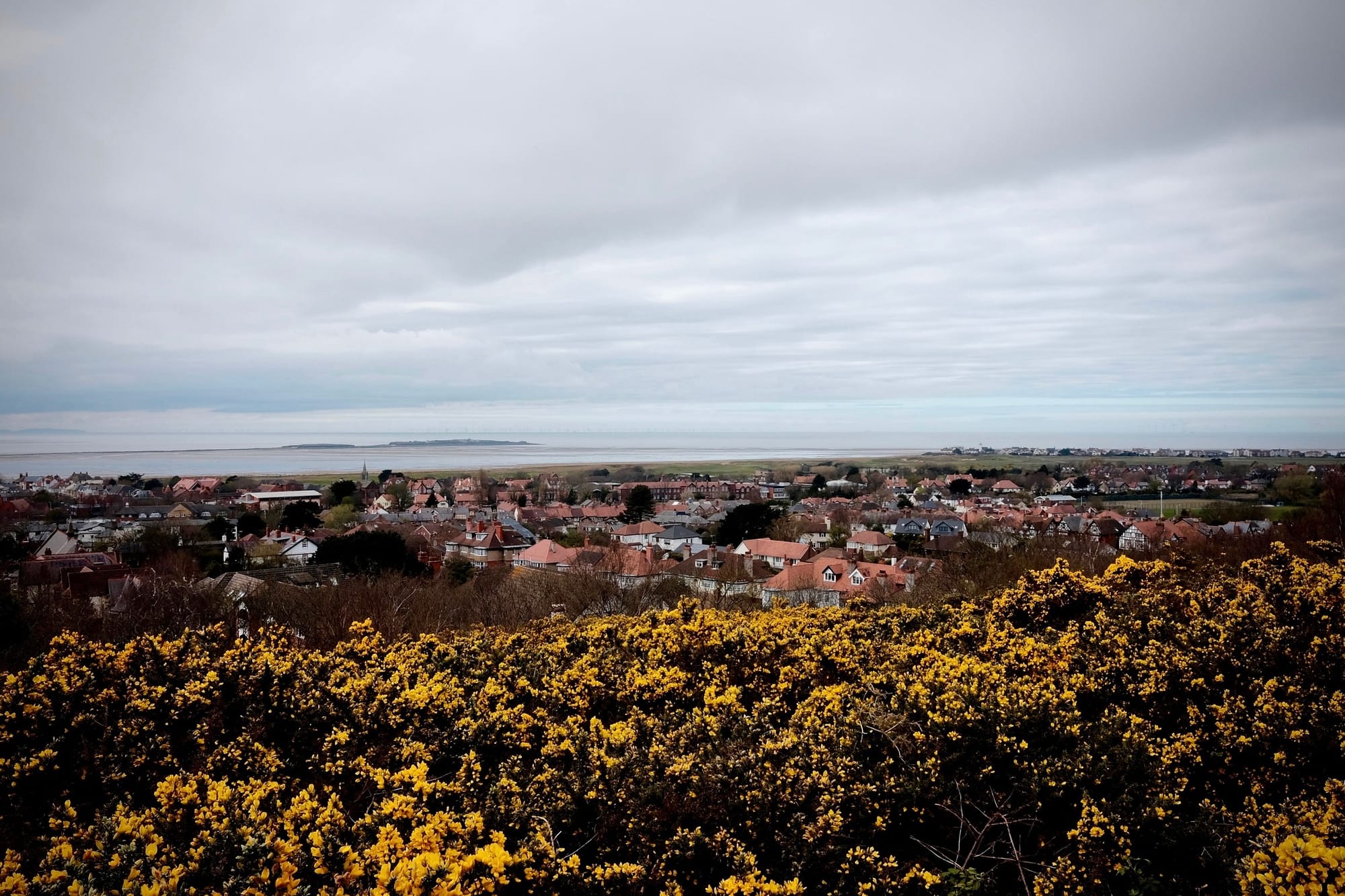
The Gawain poet might have described Wirral as a wilderness, but the area around Meols was an important settlement in ancient times. For thousands of years, people made use of a natural harbour called the Hoyle Lake, which later gave its name to the nearby town. We know about their lives because artefacts they left behind were washed onto the beaches when the tides, storms and dredging of the 19th century eroded 500m of coast in less than a hundred years. Dove Point, then a sandy promontory, disappeared.
In more recent times, Wirral has been home to former champion cyclist and current National Active Travel Commissioner, Chris Boardman. I can see why he likes it: thanks to a network of old railway paths, it looks possible to ride largely off-road all the way from Birkenhead to Chester. In the evenings at our rental cottage, I scrolled across Ordnance Survey maps and dreamed of returning to Wirral to explore by bike.
Sir Gawain rode a powerful war horse called Gringolet. In my dream-poem, I’d ride my gravel bike through Wirral’s edgelands and coastal margins. I’d encounter Chris Boardman and, after complimenting me on my pedalling technique, he’d listen intently to my thoughts on how to build a nationwide network of cycling paths. Then we’d find the largest slice of gateau on the peninsula and challenge it to a duel with our cake forks.
Boardman has called for better integration of cycling and public transport, and Merseyrail has a reputation as a bike-friendly train company. We didn’t put this to the test, but we took advantage of the frequent service to travel into central Liverpool. Once there, restless to keep moving, we walked down to catch the ferry and see the city from the water.
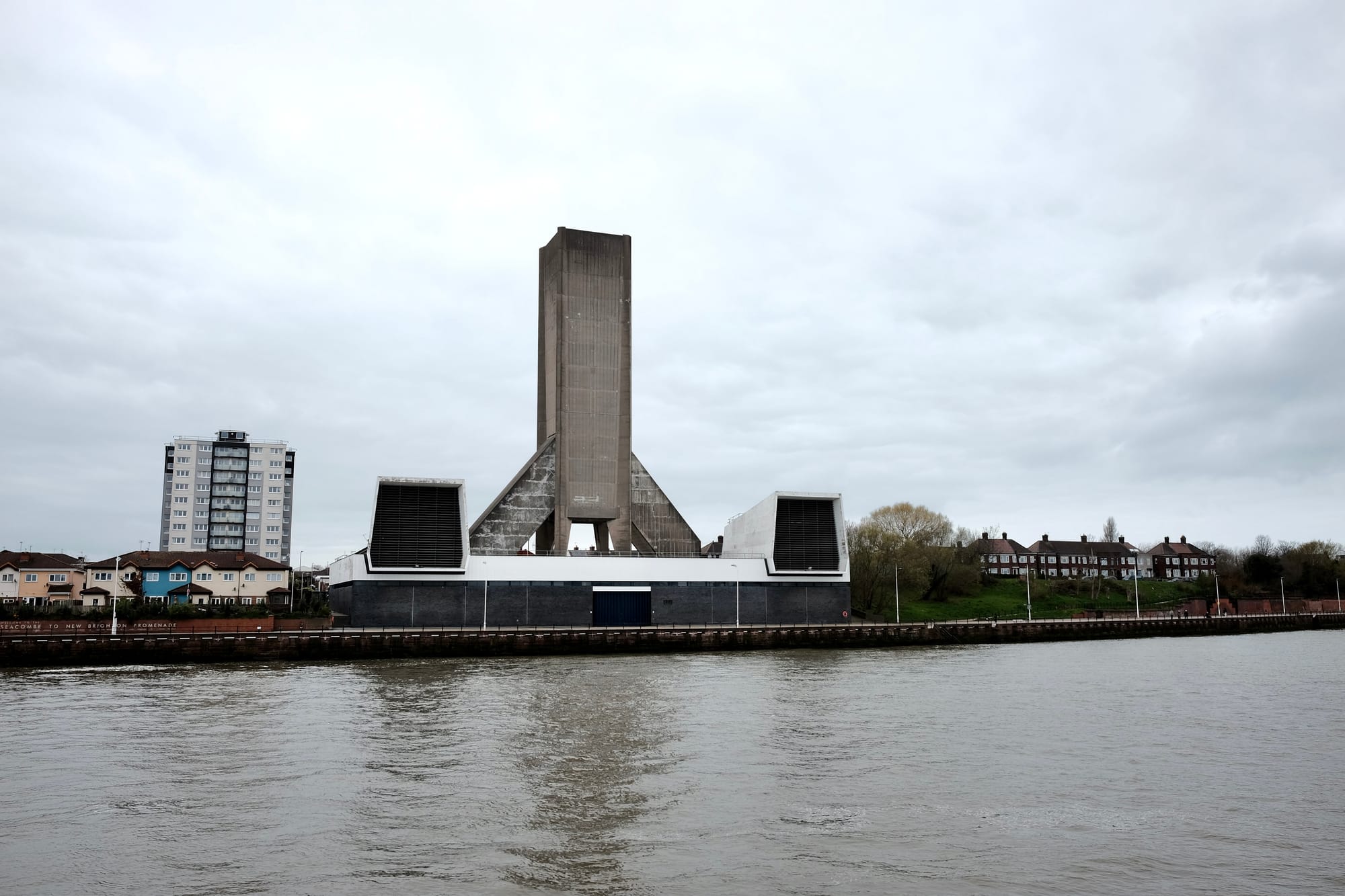
The view unfurled before us. On the Birkenhead side, the Kingsway Tunnel vent rose from the shoreline like a vast concrete space rocket awaiting launch. Further upstream, tugboats busied themselves hauling a giant Royal Fleet Auxiliary ship across the water from the Cammell Laird shipyard.
Liverpool was hard at work. We, though, were not. So after we’d disembarked, we passed the next hour or so browsing in a dog-friendly bookshop.
Get my email newsletter
Sign up for FREE and treat your inbox to thoughtful writing about life on foot and awheel. No spam. Unsubscribe anytime.