
Along the foreshore
Moving through the liminal space where sea meets land, we’re immersed in a transitory world.

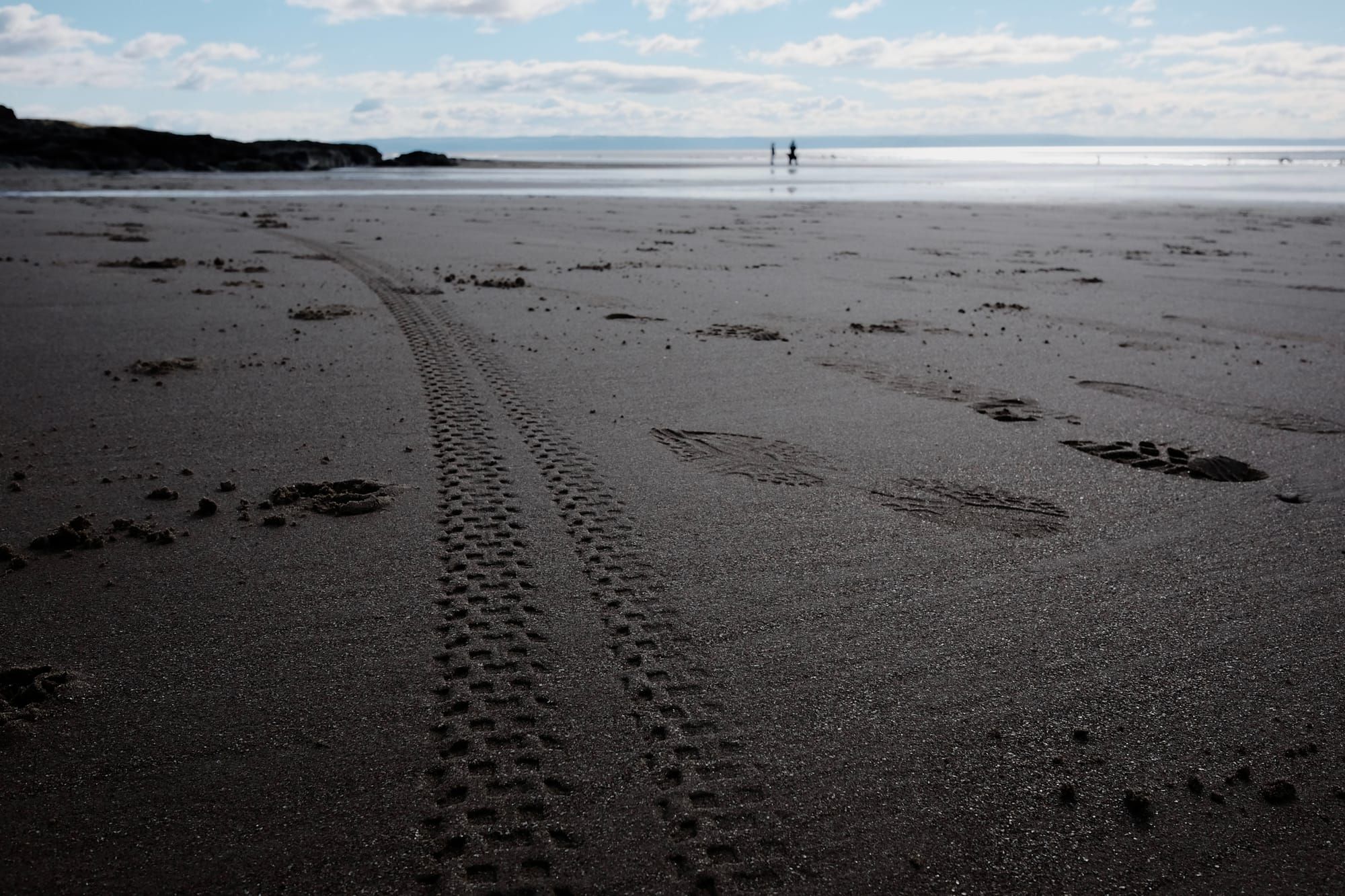
Walking along the foreshore never gets old. Where else can you leave footprints on land that exists only fleetingly, at the discretion of the moon?
For a few hours this half-term holiday, our footprints meandered across Sandy Bay. Six years had passed since we’d visited this Porthcawl beach; recent trips had taken us to nearby Rest Bay, for the surfing, and Kenfig, to walk the dunes and sands of Sker.
On our last visit to Sandy Bay, we rented fatbikes and left tyre tracks instead of footprints. Corum said he had wondered whether to bother opening his shop that morning; it was still term time in Wales and off-season. Luckily for us, he had decided to show up. He sorted us out with some bikes and we rolled out onto the low-tide beach.
With their wide tyres, the bikes were our moon buggies, carrying us over a landscape we’d never been able to ride before. We floated over soft sand, emboldened to experiment and see what terrain we could conquer next: bumping down slipways, splashing through rock pools, and slithering across a dune.
To ride on the beach is to leave behind the constraints of cycling on land – the traffic, the narrow paths, even the necessity of steering in a straight line – and enter a space of joyful possibility. Whenever I see other people pedalling wide-tyred bikes across the sand, it’s clear how much fun they’re having.
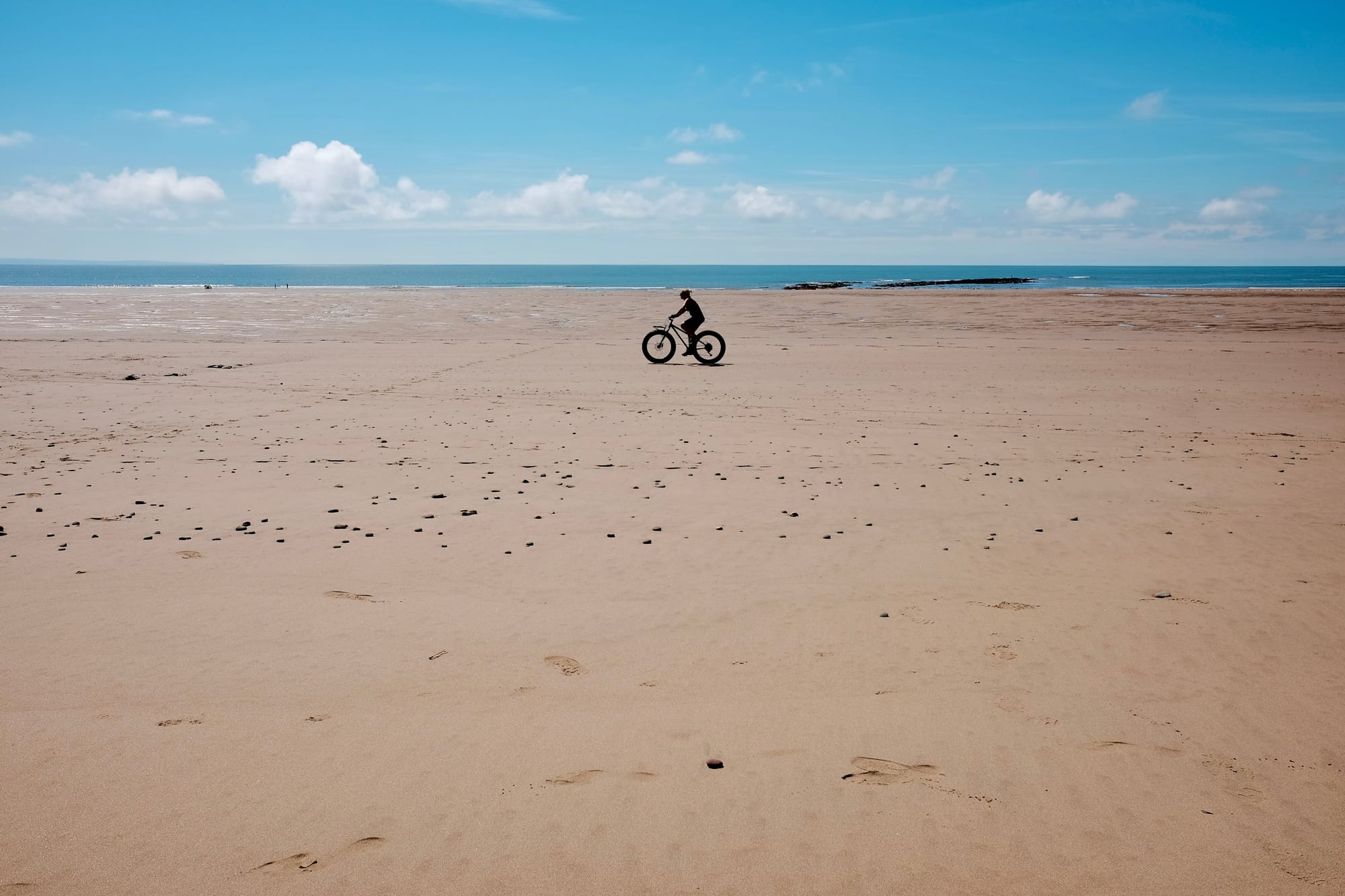
Last year, as I walked along Sker sands, a fisherman rode past me on a fat bike. He circled and detoured just for fun before parking up and walking out to a rock amid the surf, where his companion was waiting. That’s the thing about the foreshore: everyone is drawn, sooner or later to the line where sea meets sand. It pulls us in.
‘The beach is a place of strong magic,’ wrote Robert Preston-Whyte, the distinguished South African academic, geographer and author:
As a material space it is a boundary zone where the hint of celestial forces is whispered by the ebb and flow of tides, a space that is neither land nor sea, a zone of uncertainty that resonates with the sound of ever-changing seas, a setting that is, by turns, calm, tranquil, and soothing or agitated, unruly, and frightening.
On previous trips, we’ve encountered the water in full voice as the ocean roared out the last of a storm in a wall of white noise. We’ve stood in the shallows and faced the waves, feeling their salty breath on our faces and their icy grip on our feet. We’ve lingered until our toes were numb and our hair was thick with spray.
This time, despite the brisk wind lashing the top of the swell, the foreshore seemed determined to soothe us. The beach itself was in a flow state, its surface awash with endlessly fascinating patterns. Thin arcs of the incoming tide. Sweeping shadows of passing clouds. Dancing streams of sand animated by the wind.
It was a social space too. When we visit Kenfig, just outside the town, it’s not unusual for us to emerge on to the beach and find we have mile after mile of sand entirely to ourselves. But here, nearer Porthcawl, the beach was sprinkled with people and there was comfort in their presence.
The foreshore provides neutral ground, a place where everyone has something in common. When our dog took an interest in two huge Newfoundlands, we stopped to chat to their owners about their giant pets. One was placid, one excitable. Both loved water.
Therapists report that the liminal quality of the foreshore supports personal reflection and introspection, helping participants gain new perspectives and a sense of personal growth.
Our conversation concluded, we continued along the edge of the incoming tide. As we walked, we watched, out among the breakers, a lone windsurfer making their way back to the beach. For many people, the foreshore offers a place where they can step out of their comfort zone and build their confidence.
In Devon, The Wave operates surf therapy programmes for children and young people struggling with their mental health, anxiety, or social isolation. Therapists report that the liminal quality of the foreshore supports personal reflection and introspection, helping participants gain new perspectives and a sense of personal growth.
G has certainly enjoyed learning to surf on Welsh beaches over the last couple of summers, and I’ve enjoyed watching his confidence grow. But my favourite activity is simply to walk on the foreshore at low tide. It’s a privilege to leave my footprints on this transient landscape – and comforting to know they will soon be washed away. All trace of my intrusion will be gone.
When I walked the South West Coast Path in sections with my dad, some of my favourite stretches were those where we could drop down onto an expanse of sand. I’d remove my boots and paddle through the shallows until we ran out of beach and had to ascend the cliffs once again.
‘The sea and the shore mean many things,’ wrote the author Amy Liptrot about her love of wild swimming. ‘Heartbreak and hope, mortality and beauty, transience and persistence. Its withdrawal is a little death; its return, absolute life.’
Twice each day, the foreshore is buried by the incoming tide. And twice more it is resurrected by the falling water – to await those who seek its deep magic. It remains a steadfast friend in an uncertain world.
Get my email newsletter
Sign up for FREE and treat your inbox to thoughtful writing about life on foot and awheel. No spam. Unsubscribe anytime.