
Conversations with strangers
I've come to appreciate the fleeting, chance encounters that occur when travelling by bike or on foot.

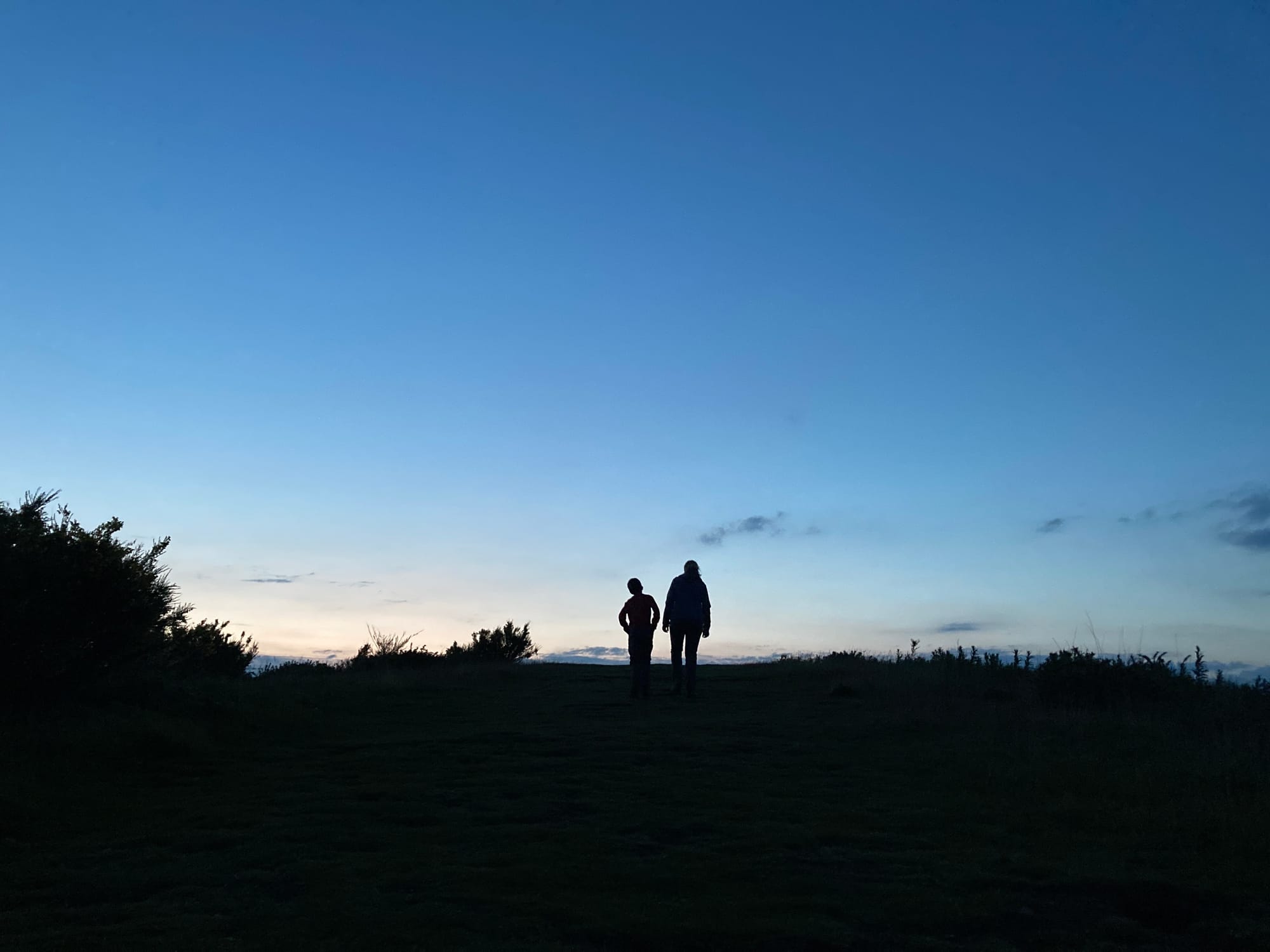
Hello. That’s my standard greeting. It’s safe, unoriginal – as befits someone who’s not a natural talker.
I remember feeling, as an awkward teenager, visceral horror at the prospect of being drawn into a conversation while I was out and about. But now I rather enjoy the interactions that journeys on foot or by bike induce.
A passing interaction on the trail has its own qualities, quite unlike those of the unhurried, sporadic conversation on a long-distance train journey. Wayside chats are brief vignettes, sometimes quite surreal and often more memorable for it.
A few years ago, I was cycling alone across a bridlepath on an expanse of common land. The landscape, lush under the summer sunshine, seemed entirely empty. And then I spotted, in the distance, a horse and rider stopped where another path crossed mine.
They stayed still as I approached, a gentle breeze stirring the horse’s tail. It felt like we had slipped into a scene from a movie. Maybe the camera was viewing us in a long shot, two tiny shapes – one edging nearer the other. Perhaps a slow, orchestral soundtrack.
As I approached the placid horse, its rider, a woman, gave no indication of why she was waiting. I stopped and said hello. We chatted about the weather, always an easy topic. But that led on to a rather strange exchange:
“It must be even hotter in Australia,” she said – not explaining why she mentioned Australia. Perhaps she has a relative there, I thought.
Convention demanded a polite, non-committal reply. “Maybe,” I said. “Although of course, it’s winter there now.”
“No it’s not,” she replied without hesitation. What could I say to that? Had I even heard her correctly?
I tried to stick to the facts – the conversation seemed to be in dire need of some. “It’s the opposite, though, isn’t it? When it’s summer here, it’s winter there.”
“That only applies to day and night.” She was adamant.
What could I say to that? I made my excuses, wished her good day and pedalled on. The conversation went around my head for the rest of the ride, and I still replay it to this day.
How does someone reach adulthood and not know that southern hemisphere seasons are the opposite of northern ones? Maybe I somehow misheard. Did the conversation even happen?
I try to approach encounters with an open mind. And that makes it all the more wonderful when they turn out to be interesting, uplifting or just mildly absurd.
In his book Talking to Strangers, Malcolm Gladwell explores the pitfalls of making assumptions about people you don’t know. He examines how indiscriminate suspicion compounded by racial bias led to a spate of police shootings in the US. And he highlights the importance of trusting strangers, even though this can sometimes turn out to be misplaced:
To assume the best about another is the trait that has created modern society. Those occasions when our trusting nature gets violated are tragic. But the alternative – to abandon trust as a defence against predation and deception – is worse.
The other week, I was riding to my local supermarket when a driver overtook me in a dangerous spot – a small uphill straight just before a sharp corner. Sure enough, a car emerged from around the bend towards us, and, finding the overtaker on their side of the road, the driver had to brake sharply to avoid a head-on collision.
A few minutes later, inside the supermarket, the driver approached me as I stocked up on chocolate: “Sorry, I shouldn’t have overtaken you there. It’s just that you were going much faster up that hill on your bike than I thought.”
It wasn’t what I’d expected. In my experience, drivers rarely acknowledge or apologise for their mistakes or bad behaviour. And, in turn, that encourages me to assume the worst of them.
But this fellow human being, flawed but friendly, didn’t seem to deserve the anger that had risen in me during the split-second incident. They were clearly aware of their error and sorry for it.
“That’s okay,” I said. And I meant it.
Research shows that briefly chatting with strangers humanises others for us and contributes to our own wellbeing. Minimal social interactions, as psychologists call them, make us feel happier and increase our sense of belonging.
In the words of actor Bob Hoskins in that 90s phone advert: it’s good to talk.
Get my email newsletter
Sign up for FREE and treat your inbox to thoughtful writing about life on foot and awheel. No spam. Unsubscribe anytime.