Finding balance

The art and science of keeping upright is essential for cycling and life.
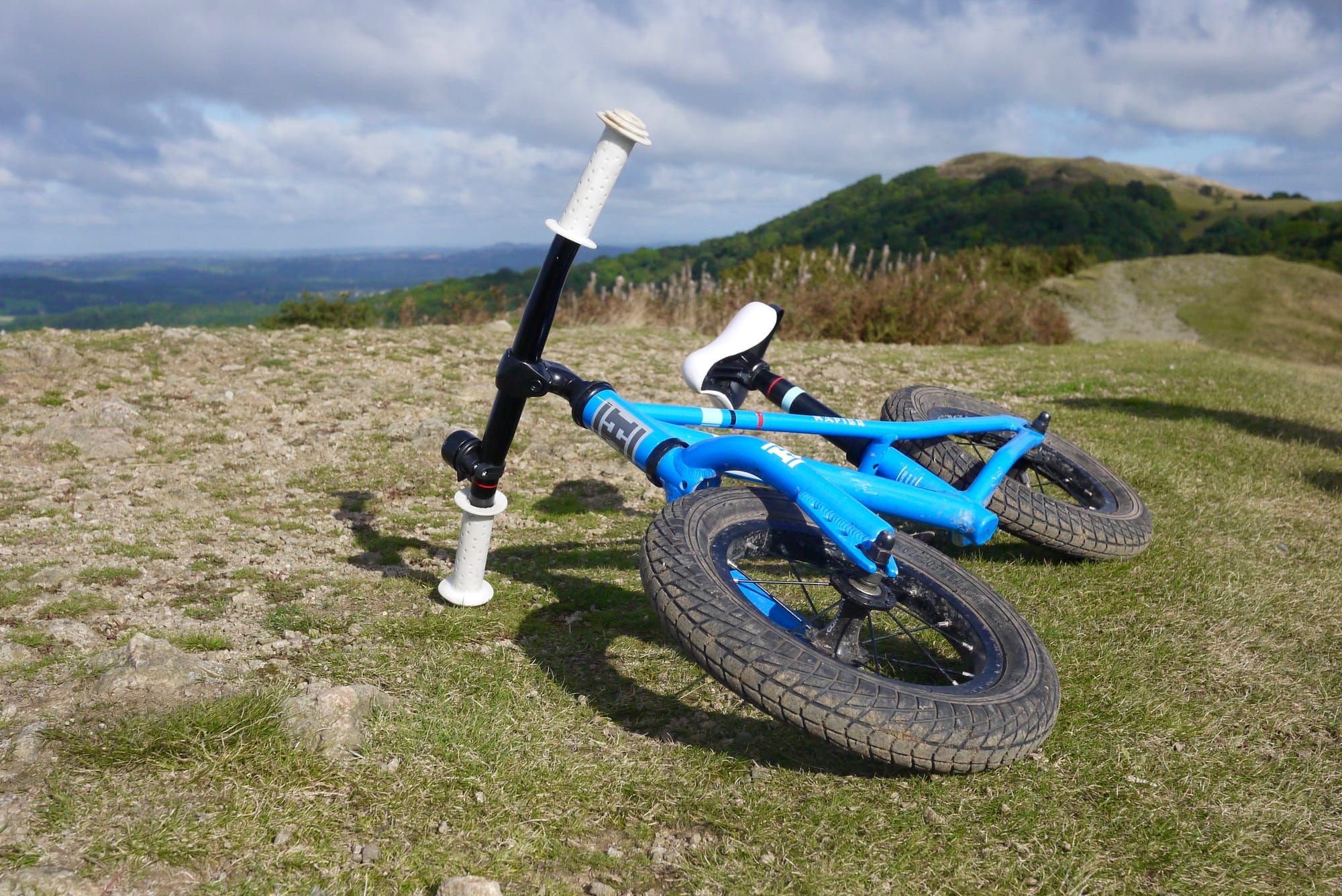
A blue Hoy balance bike rests on its side atop a grassy hill, with a cloudy sky in the background.

Balance bikes are beautiful, simple things. They distil cycling down to its most fundamental skill and help children master it. Learning to turn pedals, pull a brake lever or change gears can wait. Because none of these things are any use without balance.

My son’s journey with his balance bike, a little blue Hoy, began nervously on our back lawn. G turned the new bike upside down and spun the wheels with his hands. He eyed it suspiciously. Of our suggestion that he get on and try riding, he seemed to be thinking: “Are they crazy?!”

After a while, he did right the bike and climb on. At first he’d simply shuffle along astride the top tube. But his confidence grew. And before long he was off, drifting into corners with one foot down like a speedway rider. The transformation was remarkable, and well worth the shoes he wore out.

We’d set off for long walks on the hills. Well, the dog and I would walk; G would wheel along on his balance bike, his small presence incongruous in the big landscape. He was a naturally cautious child, but the little bike expanded his ambitions, the miracle of balance enabling him to glide along. Inevitably he grew tired, and inevitably I ended up carrying both him and his bike the rest of the way. But, in terms of his cycling journey, there was no turning back.

A child wearging a blue helmet and yellow coat rides a balance bike along a hilly path in winter. A tree arches over the path and another hill pokes through low cloud in the distance.

What G had mastered, without realising it, was the complex biomechanical processes needed for cycling. There are two main ways to balance a bike: steering and body movement. Steering is essential; it’s what allows a rider, in technical terms, to bring the base of support back under the centre of mass. 

The way a riderless bicycle recovers its balance shows just how important steering is. I watched Andy Ruina, Cornell professor of mechanics,chasing a riderless bike across a car park. As the bike slows, it leans to one side, threatening a fall. But the lean causes the handlebars to swing in that direction, correcting the bike’s balance and enabling it to continue. The pattern repeats until the bike loses momentum.

Exactly how a bike does this has been the subject of research by Ruina and his colleagues. They established that ‘design variables, like the front mass location and the steer axis tilt, contribute to stability in complex interacting ways’. I’m not really sure what all that means, but I think it shows what a complex thing a rider is doing, albeit almost subconsciously, when they take on the job of balancing.

Body movements are less important than steering for learner riders like G on his balance bike. But they’re useful for more experienced riders, who can employ them to ride with no hands on the handlebars or go fast around corners. (Essentially, you’ll definitely fall off if you don’t steer, you only might fall off if you don’t move your body.)

A child in a blue coverall rides a balance bike along a forest track covered in leaves and surrounded by tall trees, with a brown dog in front of him.

But, astride that little blue balance bike, G didn’t just learn to steer and lean; he learnt the importance of motion. Because, as anyone who’s attempted a track stand knows, balancing on a bike is much easier when you’re moving. This applies to more than cycling. As Albert Einstein supposedly said, “Life is like riding a bicycle. To keep your balance, you must keep moving.”

If you stop the world because you want to get off, then – more often than not, like a cyclist who’s forgotten they’re clipped into their pedals – you fall over. That’s been my experience. When I didn’t know which life or career path to take after finishing university, I chose none. I stopped, returning home and falling into a series of unsatisfying temp jobs. Like an inexperienced rider attempting a track stand, I lost my balance.

What would I say now to my younger self? Simply this: have the courage to keep moving. Pursue your interests, no matter how unlikely the prospect of earning a living from them seems. Walk or ride a bike a long way. Something will come from it, even if it’s only a lot of fresh air and exercise. Maybe that’s enough.

As it was, I did none of these until years later. That’s the thing about falling down: it can take a long time to pick yourself back up again. So now I’m determined to keep moving, to balance life in a way that works for me. Like riding a bike, I find this requires regular steering adjustments to keep me upright and on course.

I have a notebook on my desk, and each day, on a new page, I write six words in red ink. These are actions that I know help to keep me in balance. The more I include in my day, the better balanced I feel.

  • Read (preferably fiction, with all its wellbeing-enhancing qualities).
  • Write (because writing should be a practice, not a process – part of daily life).
  • Move (in search of the clear-brained, sleep-inducing tiredness that follows exercise).
  • Stretch (I’ve learnt the hard way what happens when I neglect this essential maintenance for my body).
  • Make (nothing else feels quite the same as using my hands to make or mend something).
  • Care (the antidote to selfish introspection: doing something, however small, for others).

There are very few days when I manage to tick all of them off, but I keep moving forward and do the best I can. That’s my approach to cycling too.

Get my email newsletter
Sign up for FREE and treat your inbox to thoughtful writing about life on foot and awheel. No spam. Unsubscribe anytime.

Sign up