
Solstice promise
On the darkest evening of the year, I’m vowing to forge a deeper relationship with the places where I walk and cycle.
Does it snow at Christmas where you live? Here in Middle England, significant snowfall at this time of year is rare. Instead, we have wet, grey days that dull my enthusiasm for walks and bike rides, driving me indoors to catch up on tasks I abandoned during the fullness of summer.
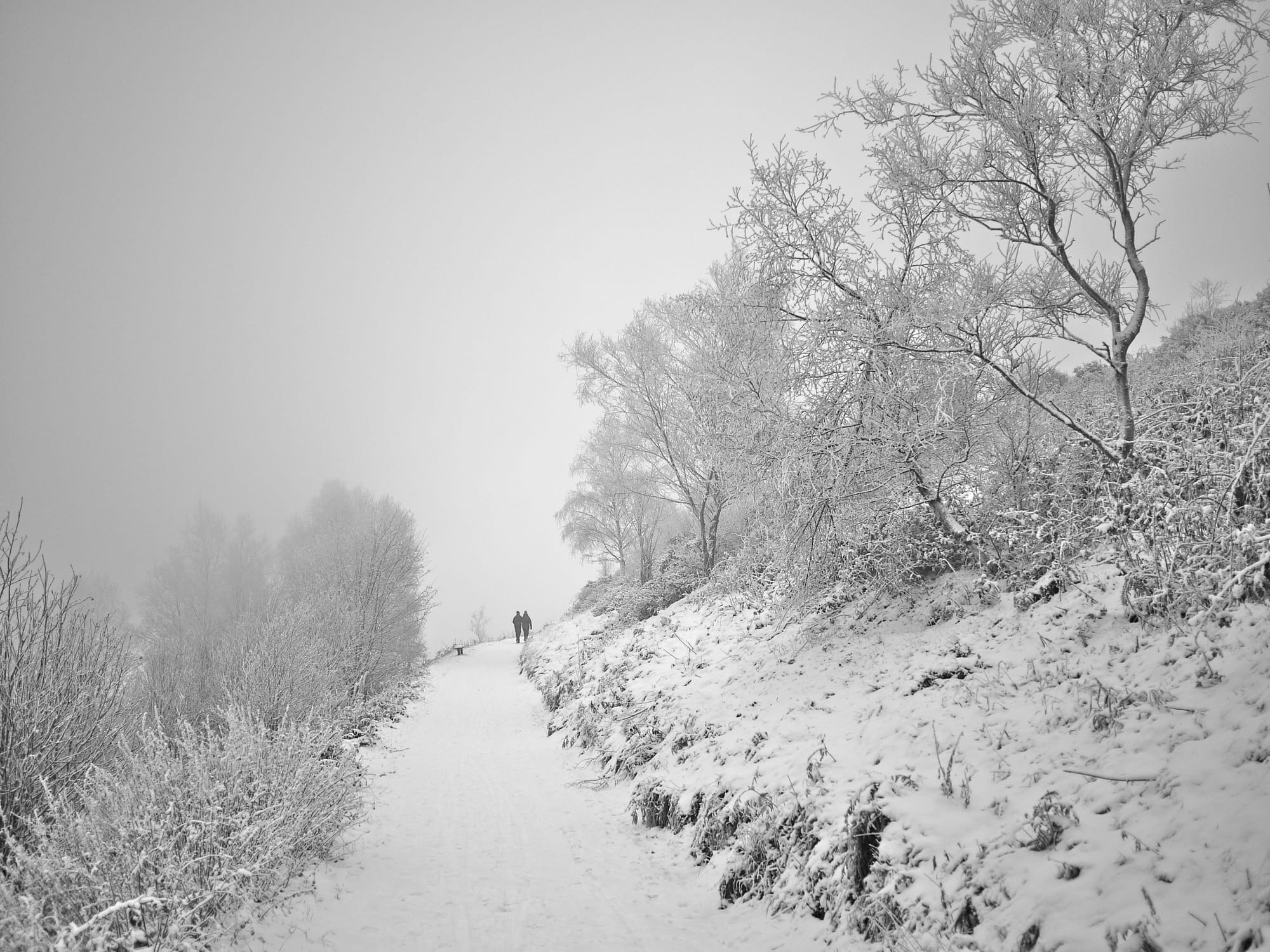
Today I was sorting through old photos when I found the images that illustrate this post. They’re from Christmas fifteen years ago, taken amidst the coldest December for 100 years. That day, J and I walked over the hills to visit my parents. The snow had thrown its usual stillness over the world, but it was the cold I remember most clearly.
As we walked, wrapped up against the biting air, the cold froze into our lives.
Temperatures dipped to -10°C. The air clawed at my lungs. This wasn’t a fleeting snowfall, a gone-by-lunchtime time out from the Christmas routine. This snow was here for the holidays. As we walked, wrapped up against the biting air, the cold froze into our lives. We knew the ageing boiler in our house would struggle, that we’d spend the next week layered in sweaters.
Having to adjust our lifestyles to cold weather is unusual these days; as a society, we’ve become estranged from seasonal rhythms thanks to the comfortable way we live. We can keep our centrally heated homes at the same temperature year-round. We can use our cars as overcoats, dashing the short distance from them back into the warmth.
Living like this might avoid inconvenience and discomfort, but it also isolates us from our surroundings. ‘To take walks in fair weather alone – remaining indoors during wind, rain or snow – is to forego half of the experience,’ wrote the explorer and philosopher Erling Kagge. ‘Maybe even the better half.’
When winter forces us to take notice, it’s a welcome chance to observe the world more closely. As J and I walked over the hills fifteen years ago, we listened to our footsteps fall softly in the snow. We watched snowflakes swirl and accumulate on the path before us. We heard them rustle against our waterproofs. And we felt the wind seek out gaps in our clothing.
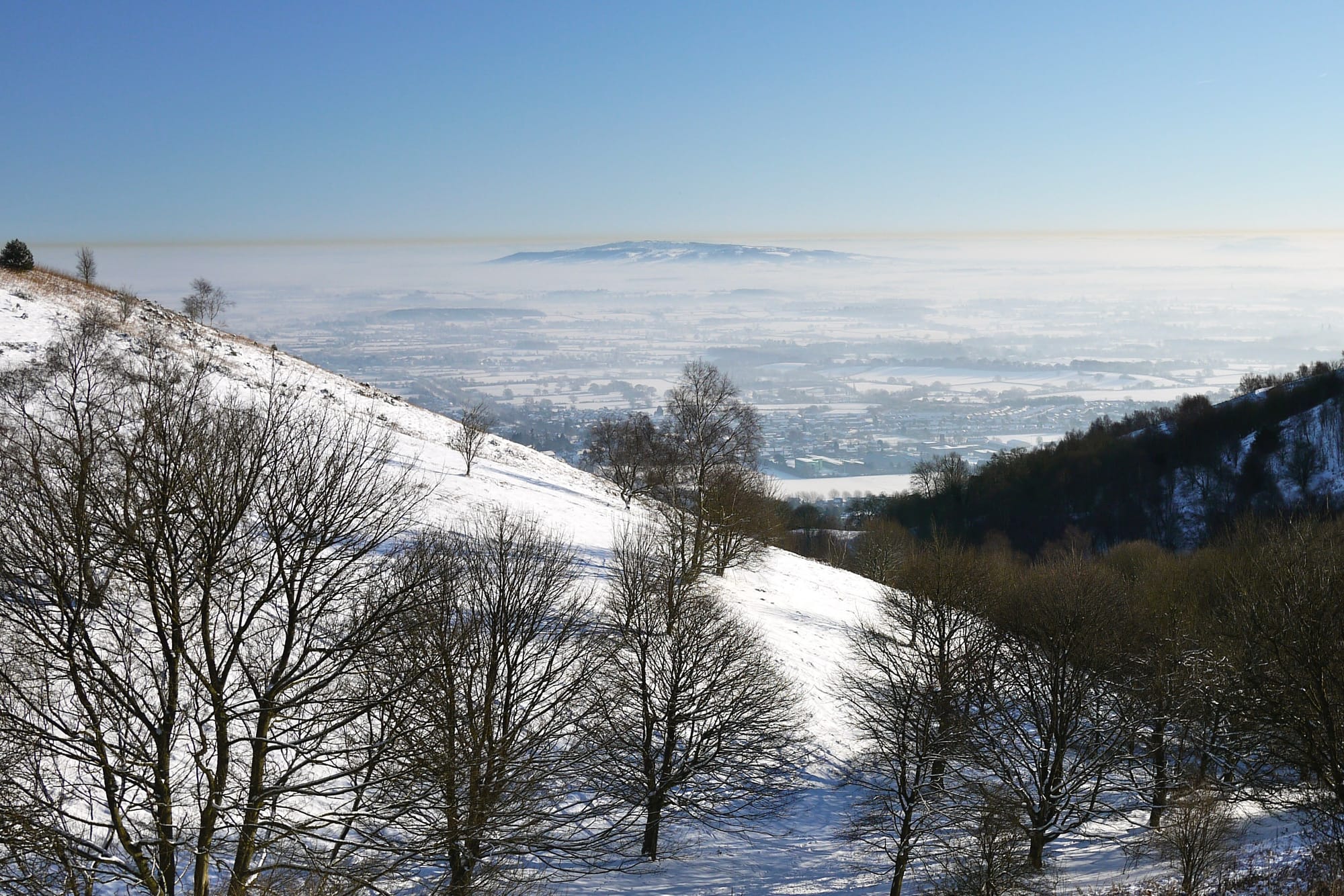
When we are forced to see, hear, and feel the world around us, we are at our most fundamentally human. Just us and nature, as it once was. Walking over the hills that Christmas, J and I quickly forgot that the land had been anything other than white, that January would bring work and bills and DIY projects. The snow gave us a blank page to rewrite our story.
It’s not surprising that literature is full of wondrous, magical worlds of snow pulling characters away from their ordinary lives. There’s Narnia, of course – as irresistible as Turkish Delight. And in Susannah Clarke’s story The Wood in Midwinter, we encounter young Merowdis Scott walking in the snowy woodland, the only place she is ever happy. Merowdis can talk to animals and trees, and we watch as her life changes forever when she adopts a baby bear.
Wintry worlds are the natural place to find talking animals and children who are kings and queens, because snow upends the usual order of things. It happens in real life, too. During the Little Ice Age between the 1600s and 1800s, Londoners set up stalls, tents, pubs, gaming areas and even printing presses on the ice between London Bridge and Blackfriars. These were the famous ice fairs.
That’s the thing about opportunities to escape from everyday life, from social conventions: they melt away all too quickly.
Because the fairs were outside parish streets and market charters, traditional controls over who could sell what, and where, were harder to enforce – lower‑status traders and performers had unusual freedom. And everyone from labourers to royalty enjoyed their wares, mingling together as they would never usually do.
The frost fairs came to an end as the climate warmed and the Thames grew too fast and too deep to freeze over. That’s the thing about opportunities to escape from everyday life, from social conventions: they melt away all too quickly.
The famous, and aptly named, poet Robert Frost captures this tension between the fleeting allure of the wild and the responsibilities of the human world. His poem ‘Stopping by Woods on a Snowy Evening’ is like falling gently into a dream that carries us to the edgelands of social order. Set on ‘the darkest evening of the year’, the solstice, it begins:
Whose woods these are I think I know.
His house is in the village though;
He will not see me stopping here
To watch his woods fill up with snow.
The narrator stands in silence save for the bells on his horse’s harness and the ‘sweep of easy wind and downy flake’. He has stopped to enjoy watching the woods fill up with snow, but society and responsibility impinge on the dreamscape: the unseen landowner, at home in the farmhouse nearby; the unnamed promises the narrator must keep; and the miles he has to travel that night.
The poem can be read as the narrator contemplating death, symbolised by the woods filling up with snow, and choosing to keep on living by continuing his journey. Frost denied this interpretation. And some people, me included, actually feel most alive in nature. I would love to stand all night and watch the woods fill with snow, but I know that I, too, would feel obliged to move on.
How, then, can I make the most of fleeting moments of wonder? Could I use a coffee stop during a bike ride or walk to observe my surroundings more closely? Could I pay more attention to how the landscape makes me feel? Should I carry a notebook on my rides and walks, to record my thoughts before they melt away?
As we stepped out of my parents’ house that snowy Christmas night to walk back home, we found the landscape frozen and eerily bright. Our route took us through an avenue of trees, and I can still see them now in my mind, silhouetted against the moonlit snow. I can feel the rush of cold air hitting my lungs, snatching my breath.
But it shouldn’t take once-in-a-generation weather to make me notice the places I pass through. So on this solstice, I’m promising myself that in the lengthening days ahead, I’ll pay more attention to what lies around me. I’ll make the most of the stop in the woods, or along the trail or by the canal. I’ll see and hear what these spaces are telling me about themselves – and about myself.
Get my email newsletter
Sign up for FREE and treat your inbox to thoughtful writing about life on foot and awheel. No spam. Unsubscribe anytime.