
Walking into darkness
The story of two winter walks, one at dawn and one at dusk, and a call to dream.
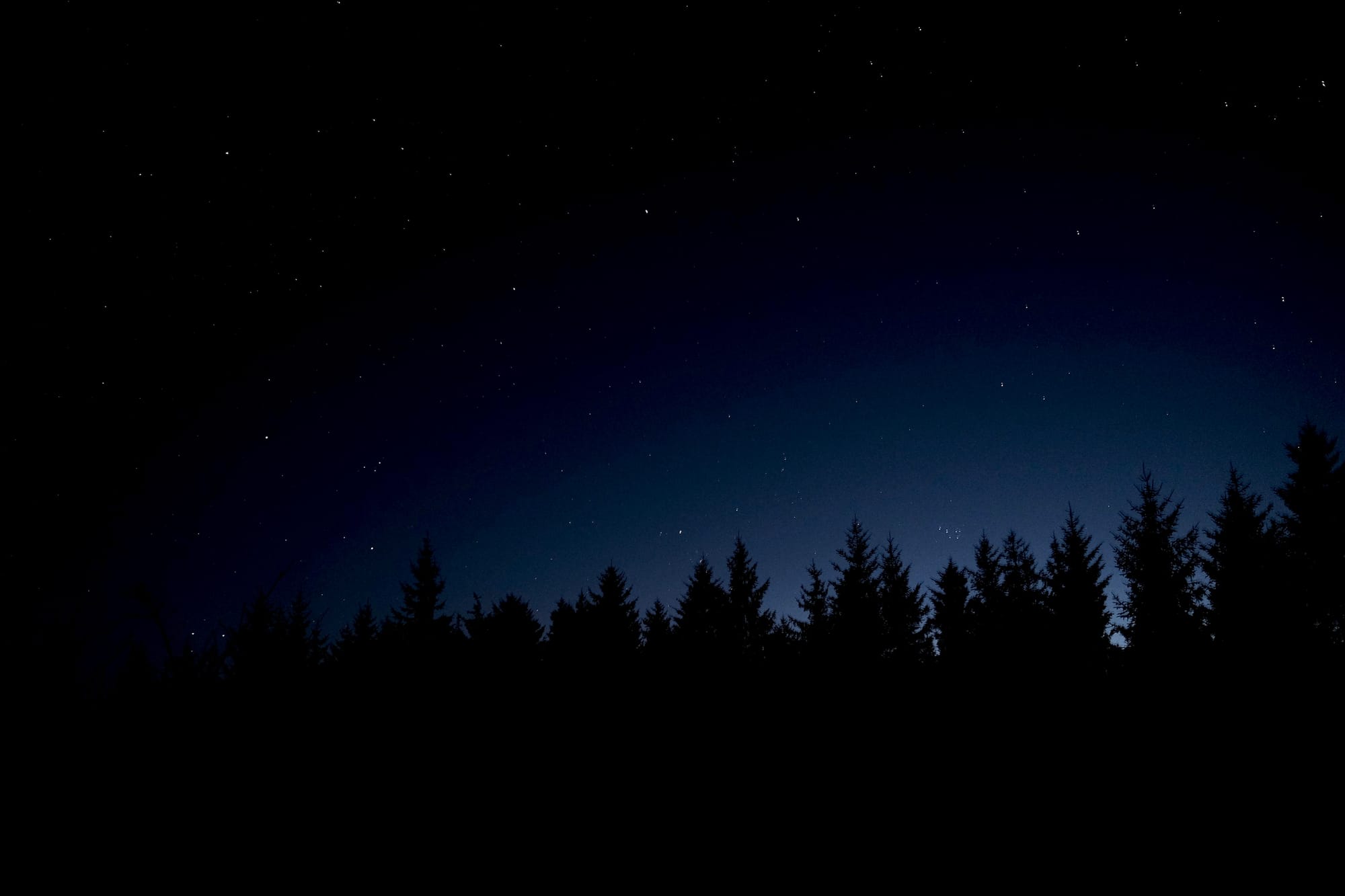
Winter is a time of walking. A season of sunrises and sunsets, halflights and shadows. Low sun highlights the contours, night erases them. I don’t bring a torch into the charcoal-black woodlands; I leave it behind on purpose and feel my way along the trail. Owls call. Deer crunch through the scrub. I am alone with them in the dark, and it feels good.
This is how I walked one moonless morning before Christmas. It was 6am, and I’d been on the hills for an hour before I passed another person. They were easy to spot; their headtorch beaming hundreds of lumens onto the path as they strode towards me. The cold white light turned our patch of night into an eerie daytime, flat and unreal. Close up, the light was blinding, and I raised a hand to shield my eyes.
My fellow walker didn’t seem to notice my discomfort, or to care. We crossed paths without greeting. Why did they feel the need for such a bright light? Why come out in the dark, only to fight its existence? I’d walked torchless miles on these paths precisely because I wanted to feel the darkness around me, to enter its world. Maybe this makes me a bit odd. Transgressive, at least.
Light is a powerful symbol in religion and culture. Its divine presence shines enlightenment upon believers, warding off the sin that lurks in the shadows. So it follows that to seek out darkness is to look for trouble, or at least to exist for a few hours beyond the gaze of polite society.
In Cider with Rosie, Laurie Lee recalls playing ‘games in the moon … games that the night demanded’. A favourite was called Fox and Hounds:
Two chosen boys loped away through the trees and were immediately swallowed in shadow. We gave them five minutes, then set off after them. They had churchyard, farmyard, barns, quarries, hilltops, and woods to run to. They had all night, and the whole of the moon, and five miles of country to hide in...
For the young Lee and his friends, darkness was freedom. In the daylight, adults would have been at work in these places and unlikely to welcome a marauding pack of boys. At night, children could reclaim them as their own, beyond adult control.
Does control explain our obsession with turning night into day? We’ve conquered the very thing – darkness – which used to determine how we spent our time: when we slept and when we woke, when we worked and when we rested. Now we can spend it online until the early hours. The internet is reshaping how we spend our time – and our money.
Between Christmas and New Year, that empty time into which days tumble, I try to take a break from browsing the web. I read books. I watch films. And sooner or later, I feel the urge to wander through the last days of the year, often exploring somewhere new on a whim. One afternoon, I found myself walking past the forlorn Express and Star building in Wolverhampton.
Even when we’re offline, we’re never far from the impact of the internet. The newspaper seems to be descending into the same swamp of crime stories and clickbait that has consumed so many other local titles as their traditional business model – built on classified ads – collapses. Now surplus to requirements, the building that carries its masthead is to be redeveloped into flats, shops and a gym.
Local high streets are suffering too, as shops struggle to pay their way and online competitors undercut them. If they shut their doors permanently, everyone loses amenities they can walk to easily. In Wolverhampton city centre, I made my own small contribution to the local economy: buying a pasty and a hot drink.
What the cold does for plants, darkness does for humans.
It was too cold to pause for long, so I traced a route towards the Birmingham Canal. The plan was simply to keep walking until I’d had enough, then hop on the tram. The easy navigation along the towpath would be welcome for a mind softened by days of Christmas television, and legs stiffened by too much time on the sofa.
Along the canal, the thick cloud was smothering daytime into a drawn-out dusk. A tunnel closed in around me, barely above head height. It felt appropriate for a city whose story starts in the Dark Ages – that period about which we can catch only glimpses.
Over subsequent centuries, the Staffordshire town – as it was before becoming a city of the West Midlands – found itself at the centre of the wool trade, lock manufacturing and mining. From the black of coal mines, forges and foundries, Wolverhampton fashioned prosperity. Out of darkness cometh light, as the city’s motto goes.
These words also remind us that the dark days don’t last forever, that even in the lifeless depths of winter new shoots are preparing to burst through. What’s more, many of those shoots rely on the cold days to flourish later. It’s a process gardeners know as vernalisation. The yellow rattle seed I sowed in my wild front lawn needed to lie dormant over the winter before it would germinate.
What the cold does for plants, darkness does for humans. We rely on it to sleep and regenerate for the day ahead. It also connects us directly and powerfully to the universe itself. We can travel thousands of light-years in time, understand some of the complexity of the cosmos, and navigate across the landscape through a wonderously simple act: looking up at the night’s sky.
But our obsession with light is damaging our children’s chances of seeing the stars when they’re grown up. In 2023, Christopher Kyba of the German Centre for Geosciences showed that light pollution is causing the night sky to brighten at a rate of around 10% a year. A child born where 250 stars were visible at night when Kyba published his research will only be able to see about 100 by the time they reach 18 years old.
Imagine what could happen if we used dark hours to dream of new ways to live and work, instead of trying to fix the ones that lie broken around us.
‘To walk for hours on a clear night is the largest experience we can have,’ wrote Thomas A Clark in his poem ‘In Praise of Walking’. Why would we deny our children that experience? Why would we not want them to walk under stars, exploring a landscape rendered unfamiliar by the hard-shadowed moonlight? Why would we not invite them to share the world of the bat, the owl and the badger?
There are some good reasons to light the darkness – safety, for one. But there are many bad ones too. And often, there is no reason at all. We do it just because we can, because LED lighting is cheap and powerful. Because more light is better than less. Day is preferable to night.
This attitude seeps into every aspect of our thinking. We hate being in the dark, not knowing the answer. We seek to shed light on our problems. But what if problems don’t need light, but darkness? Imagine what could happen if we used dark hours to dream of new ways to live and work, instead of trying to fix the ones that lie broken around us.
Out of the wreckage of the local newspaper industry, new email publications are emerging (such as The Dispatch) focussed on slow, thoughtful and high-quality journalism. Similarly, when my own town’s only bookshop closed, the community responded by opening their own: a cooperative.
Reader-supported journalism and community-owned bookshops are the stuff of dreams. They are the ideas that reveal themselves when we step out of brightly lit corporate offices into the wild darkness. When you switch off the dazzling billboards promoting failed ideas and bankrupt business models, you can see that other paths are open to you.
By the time I had walked a few kilometres more along the canal from Wolverhampton, the last of the daylight was fading fast. Leaving the towpath, I made my way to the tram stop at Loxdale and waited for my ride into Birmingham. It arrived, headlights blazing and orange destination sign shining through the gloom.
I used to be afraid of the dark, of how I’d get through the short days and long nights of winter. The answer, it turned out, was not to mourn the loss of summer but to welcome winter and explore all that it has to offer.
And that includes the chance to walk, and dream, in darkness.
Get my email newsletter
Sign up for FREE and treat your inbox to thoughtful writing about life on foot and awheel. No spam. Unsubscribe anytime.