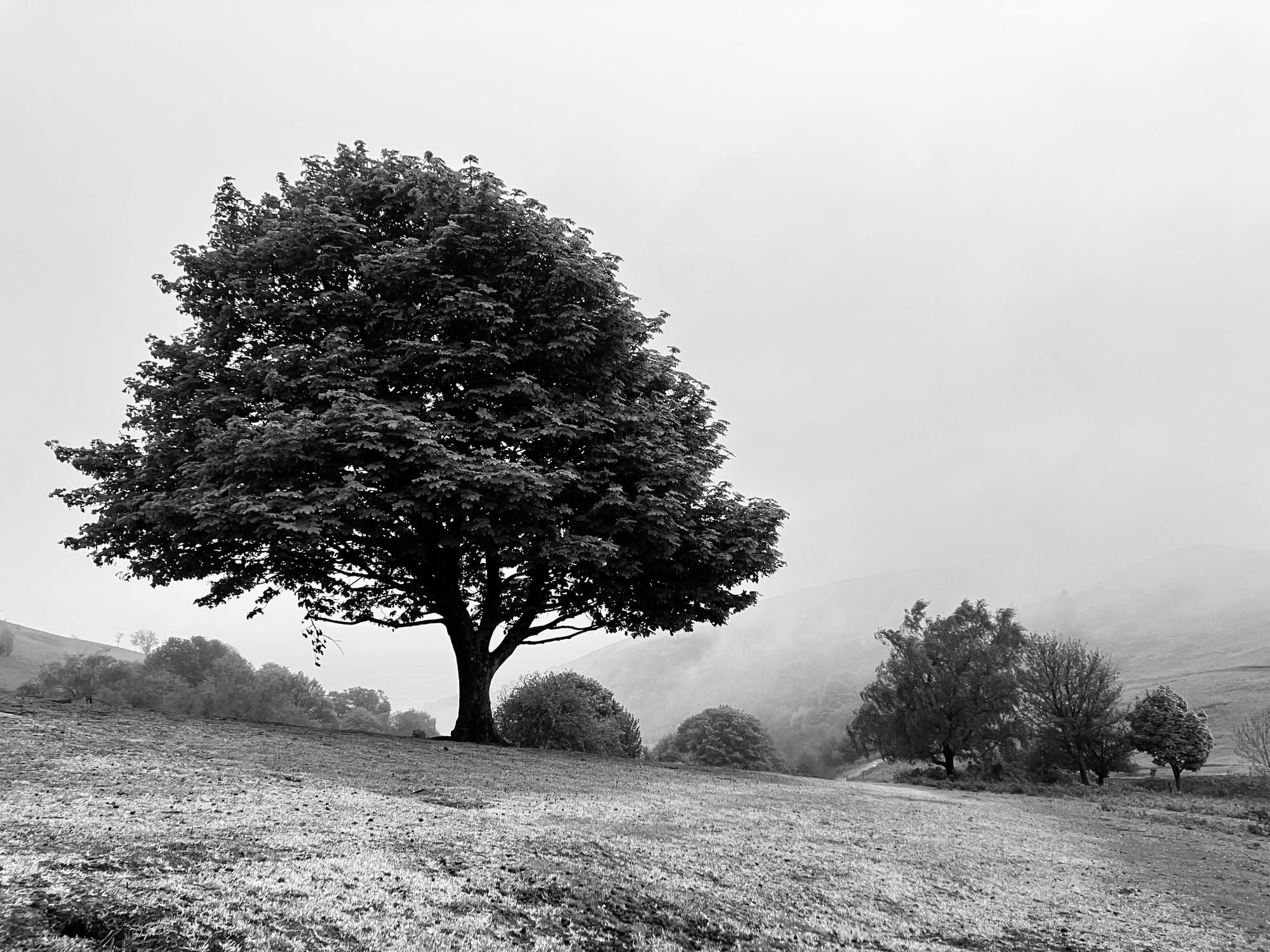
You did not walk with me
When my mum was seriously ill in hospital and not expected to live, I sought solitude on an early morning walk.
Sadness overwhelmed me in the night, and at daybreak I gave up on sleep and slipped downstairs to rouse the dog. I grabbed her lead from the hook by her bed, clipped it on to her collar, and we tiptoed out of the house together. The skittering of claws on the pavement was the only sound in the hushed dawn.
A car or two, early commuters on their way to work, rolled past us as we followed our regular route out of town. We turned onto footpaths, winding our way up towards the higher slopes. From there, I could see the hilltops still shrouded in cloud, as if they were pulling the duvet over their heads, unable to face the day. I knew how they felt.
Walking was at least better than lying awake with my grief and despair; it satisfied a need to be alone and sad. I believe it’s important to make room for emotions perceived as negative; that feeling these strongly is as vital as being happy or joyful. In the words of writer Susan Cain in her book Bittersweet: How Sorrow and Longing Make Us Whole:
The tragedy of life is linked inescapably with its splendour; you could tear civilisation down and rebuild it from scratch, and the same dualities would rise again. Yet to fully inhabit these dualities – the dark as well as the light– is, paradoxically, the only way to transcend them.
It had been years since my mum had been able to walk up here on the hills, but I missed her even more intensely because of it. Thomas Hardy wrote about this peculiar kind of absence in his poem The Walk, in which he follows his regular walking route after his wife Emma’s death.

‘You did not walk with me / Of late to the hill-top tree,’ Hardy’s poem begins. Although he has walked alone for some time – Emma having been too weak to accompany him – the experience is entirely different, emptier, after she dies. Everything looks the same, but nothing feels the same because of the void awaiting him at home. That’s how I felt.
My mum gave me my love of walking – it’s how we got around together in my early years:
Three decades ago I walked through the chestnut avenue on my way to the village school. Walking was normal. We had a car, but that was for my dad to get to work in the city. My mum and I got around most places on foot. When we had to go further afield, we walked up to the bus stop in the village or across the fields to the train station.
From: Walking Has Become a Radical Act
Now it seemed that part of my life was fading with her: I’d never walk with my mum again. Not just up there, but anywhere. Not ever around the house with her walking frame, or out into the garden to get some fresh air. These thoughts overwhelmed me. And there, on my favourite hilltop, I slumped to the ground, crying into the swirly clouds.
Those weren’t the only tears that day. After the dog and I made our way home, I caught the train to the hospital. The notebook I kept from that time tells me I took a portable speaker to play my mum some of her favourite music. “I like this one,” she said as she heard the distinctive piano melody of Farewell to Stromness by Peter Maxwell Davies. We listened to the rest in silence and I cried as the final note faded.
The piece was composed in 1980, in protest at proposals for a uranium mine near where Maxwell Davies lived in the remote Orkney Islands. It was a cause my mum would have supported wholeheartedly. She grew up in a crowded city but sought the quiet of the countryside where we lived, immersing herself in long, aimless walks in nature while my dad and I were at work and school.

Despite a debilitating genetic bone condition, she took walking holidays in the Pyrenees. She walked the Cotswold Way with my aunt, and the Limestone Way with my dad. She enjoyed defying expectations, proving the doctors wrong. Now, though, it seemed her journey was coming to an end as health conditions caught up with her.
In his poem In Praise of Walking, Thomas A Clark wrote that 'the most lonely places are the most lovely'. There are few places lonelier than the landscape of grief. But in my notebook, I wrote of my desire to consider walking there as a privilege – to embrace the opportunity to share the end of a loved one’s life. To hold her tight, then let go.
After another week of sleepless nights and early-morning walks, we got the news that my mum, miraculously, could live. There was a chance. Then could live became would live. She left one hospital, transferring to another. As I write this, several months later, she has taken her first steps – two of them, from a bed to a chair.
When I walk the dog on the hills, I can see my parents’ house nestled between the fields. There, from a hospital bed squeezed into the lounge, my mum is re-learning to walk, one step at a time.
Get my email newsletter
Sign up for FREE and treat your inbox to thoughtful writing about life on foot and awheel. No spam. Unsubscribe anytime.